

Round Handbag

A round handbag solves a familiar styling problem: carrying daily essentials without the rigid, office-like appearance of a rectangular tote. The round handbag creates a clear circular silhouette while retaining the handles, secure closure and organised interior expected from a true handbag rather than a decorative novelty.
Its curved body feels compact against the hand, yet a well-designed gusset can accommodate a phone, card holder, keys and small cosmetics. Materials ranging from smooth leather and lambskin to woven rattan, tweed and beaded fabric change the mood without obscuring the recognisable circle. Explore the available sizes, check the opening width and compare carrying options below to select a piece that works comfortably from daytime errands to an evening event.
Unlike a flat circle purse, a functional round handbag needs depth. The gusset—the strip joining the two circular panels—determines whether the bag merely holds cards or carries a complete daily kit. A depth of 5 to 8 cm generally provides room for a slim wallet, compact phone, keys and lip product while preserving the rounded profile. Larger belongings should be placed centrally so the front and back panels remain smooth.
The curved interior has no square corners, so loose objects naturally settle at the bottom. A lining pocket keeps small items from moving, while a full zip gives a wider, more secure opening than a short top closure. Compared with a tote bag, the circular handbag rewards deliberate packing but offers a more defined silhouette. For broader shape-led alternatives, browse the current handbag edits.
| Diameter | Useful capacity | Best handbag role |
|---|---|---|
| 15–18 cm | Cards, keys, compact phone | Mini evening purse |
| 19–22 cm | Phone, small wallet, cosmetics | Daily hand or shoulder carry |
| 23–27 cm | Full wallet, glasses case, travel essentials | Statement day bag |
Measure your phone diagonally as well as vertically. A device may match the bag’s diameter but still catch on a narrow zip opening.
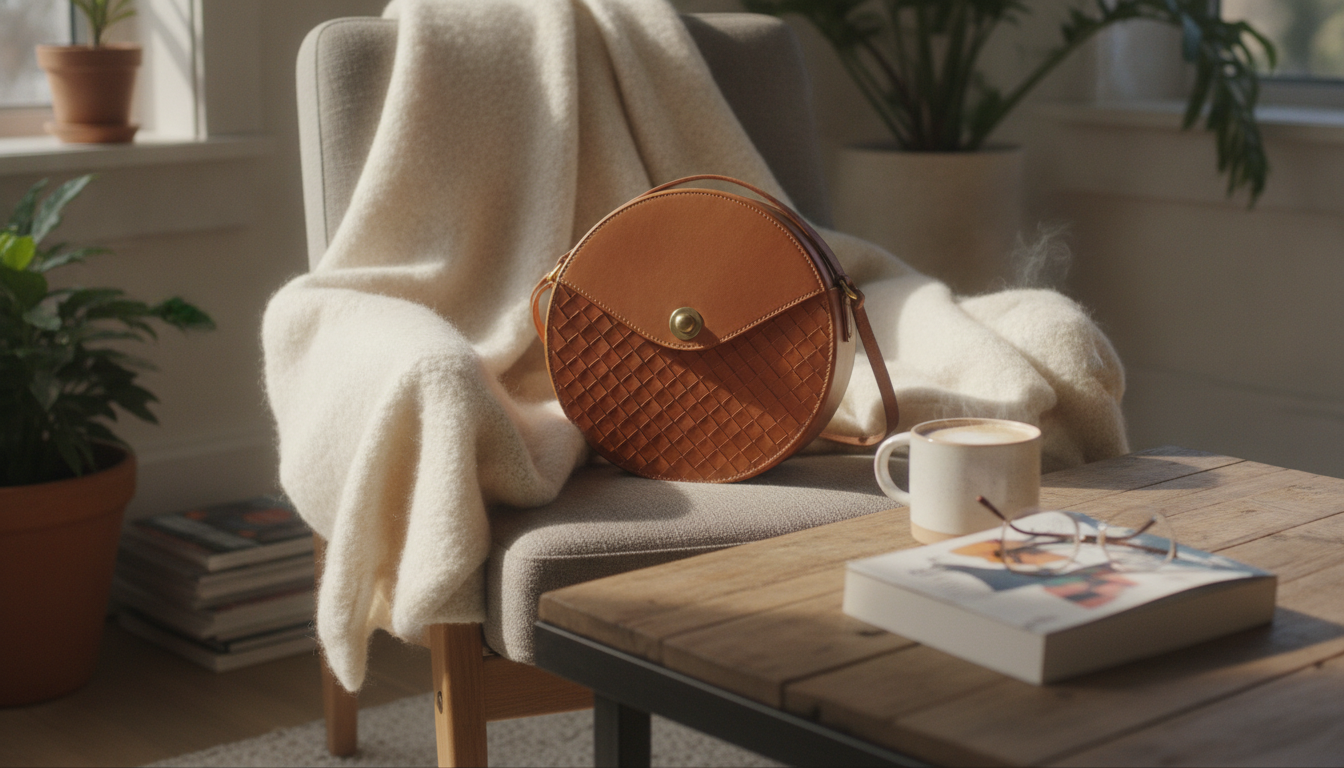
Material determines how a round handbag feels in the hand and how clearly it retains its circle. Full-grain leather develops a natural patina and offers substantial edge support. Smooth leather looks refined, while grained leather disguises light scuffs. Supple lambskin has a soft, warm touch but benefits from careful storage because pressure can mark its surface.
A pink bouclé mini design feels tactile and softly structured; gold-tone hardware or a chain adds visual definition around the fuzzy weave. Handwoven rattan creates an airy shell with a bohemian character, although its open texture calls for a fitted lining. Beaded or hand-painted designs turn the circular panel into a decorative surface. Those seeking reduced dimensions can compare the compact handbag range before deciding how much capacity they need.
| Material | Touch and structure | Care priority |
|---|---|---|
| Full-grain leather | Firm, substantial and naturally varied | Condition sparingly and protect from prolonged moisture |
| Lambskin or soft leather | Silky, flexible and lightweight | Avoid abrasion and overfilling |
| Bouclé or tweed | Textured, soft and visually dimensional | Lift dust gently; never pull loose fibres |
| Woven rattan | Dry, lightweight and sculptural | Keep away from rain and crushing pressure |
Colour also changes the visual weight of the circle. Black, navy, taupe and cognac create a grounded, year-round handbag, while blue, green or deep mauve remain versatile without looking strictly neutral. Pink and other colorful finishes emphasise the geometric outline. A checker pattern, floral fabric or artisan-painted panel makes the round leather handbag more expressive than standard rectangular designs.
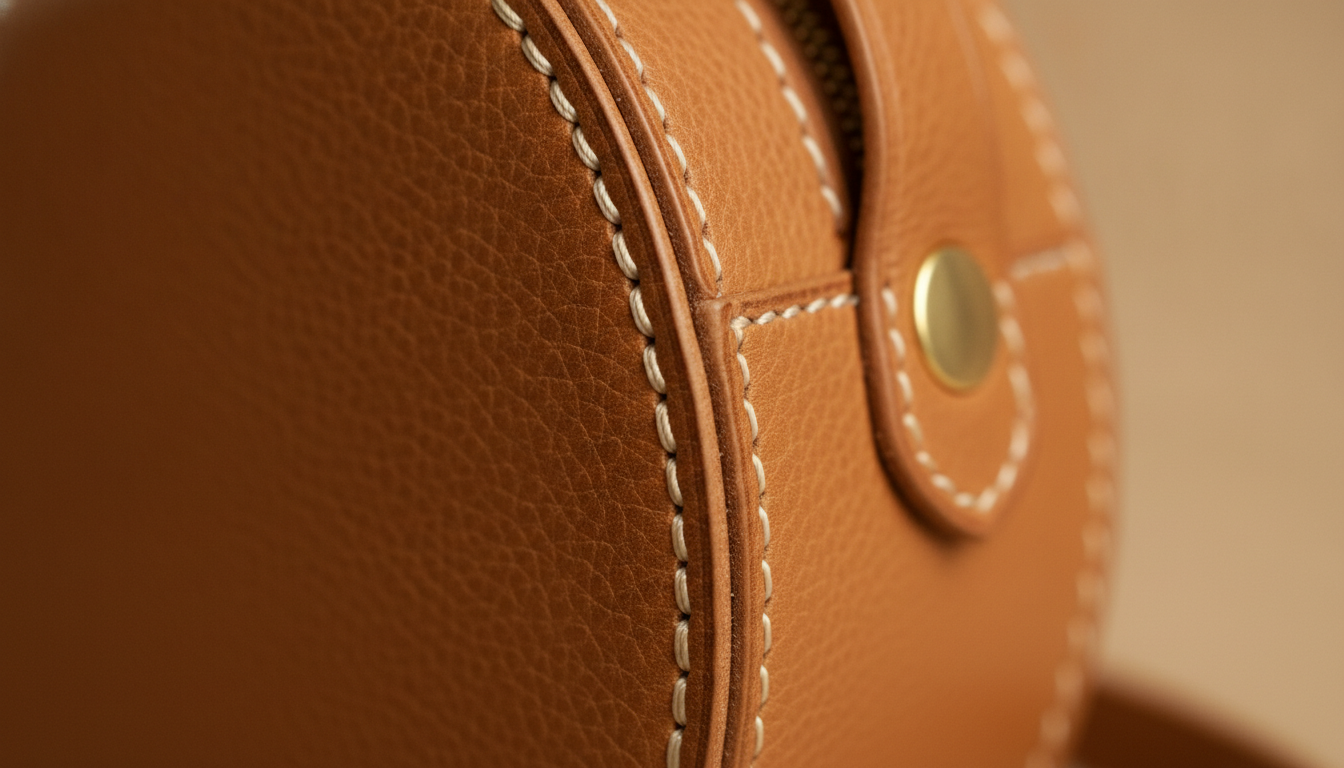
“Genuine leather” describes composition, not grade. Examine grain consistency, edge finishing, lining attachment and stitch spacing to judge construction quality.
A circular body has less contact with a flat surface than a conventional handbag bottom. This makes the lower edge vulnerable to rubbing when the bag is set down. Bottom studs create small points of elevation, while a reinforced gusset distributes weight between the two main panels. Steel hardware offers durability; nickel, brass, silver-tone or gold-tone finishes can coordinate with the zip, chain and round handle.
The strap system is equally important. A short top handle preserves the handbag identity and keeps the circle upright. A detachable shoulder strap adds hands-free flexibility, while an adjustable crossbody strap distributes weight during travel. Compared with a chain alone, a leather shoulder section feels softer on clothing. For bolder construction and decorative shapes, explore the distinctive women’s handbag designs.
| Carry system | Practical effect |
|---|---|
| Round top handle | Keeps the bag close to the hand and reinforces its sculptural outline |
| Detachable shoulder strap | Converts the piece without leaving permanent hardware across the front |
| Adjustable crossbody strap | Allows the circle to sit above the hip and reduces repeated impact while walking |
On a round handbag, strap tabs should attach to reinforced sections of the gusset. This helps the circle remain vertical instead of folding around the connection points.
Because a circular handbag can roll or rotate more readily than a flat-bottomed bag, carrying height matters. In the hand, the body should clear the ground with the arm relaxed. On the shoulder, the upper edge should sit below the elbow for easy zip access. Crossbody, the centre of the circle should rest around the upper hip rather than the thigh, where repeated movement can scuff leather and hardware.
For styling, let the circle provide contrast. A smooth leather bag brings definition to fluid tailoring, while bouclé softens a clean monochrome outfit. Rattan works with linen and woven textures; beaded or jewel-like surfaces suit evening clothing. The handbag remains the focal object, so repeating only one detail—such as silver hardware or a pink accent—usually creates a more controlled result than matching every colour.

Start with function, then assess finish. A round handbag should open widely enough for your largest essential, stand without collapsing and remain comfortable when fully loaded. Product dimensions should include diameter and depth; a front measurement alone does not reveal usable volume.
Texture can refine the choice further. A structured embossed circular design creates pronounced light and shadow, making minor handling marks less visible than on an uninterrupted smooth panel.
A round handbag has two circular or strongly rounded main panels connected by a gusset. Unlike a flat coin purse, it includes enough depth, structure and carrying hardware for everyday essentials. It may feature a top handle, detachable shoulder strap, zip closure and protective bottom studs.
The circle provides a sculptural alternative to a conventional rectangular clutch while remaining easy to hold. Controlled sparkle can outline the geometry without overwhelming it; a crystal-detailed occasion piece illustrates how a compact handbag can carry cards, a phone and lipstick with visual clarity.
A circle offers less corner space than a boxy bag but creates a more distinctive outline and sits neatly beside the body. An unconventional circular model suits buyers who value shape and edited storage over the broad, open capacity of a tote.
Quilting adds surface relief and slight padding, but deep stitching can reduce internal space if the panels are heavily cushioned. A quilted-effect round style should therefore be judged by its internal dimensions, gusset depth and zip opening rather than its outer diameter alone.
Remove dust with a soft, dry cloth, then test any suitable leather cleaner on an inconspicuous area. Use minimal product and avoid soaking the circular seam. Allow the handbag to dry naturally, fill it lightly with acid-free tissue and store it upright in a breathable cover.
Often, but diameter alone is not enough. Compare the phone’s diagonal measurement with the clear zip opening, then account for the lining and seam allowance. A mini design around 18 cm may hold a compact phone, while larger devices generally require a diameter near 20 cm or more.
A round handbag is most convincing when its sculptural form supports real use: sufficient gusset depth, an accessible closure, reinforced strap tabs and protection along the lower curve. Choose leather for lasting structure, lambskin or bouclé for softness, and woven or decorated surfaces for a more expressive finish. Match the diameter to your phone and wallet, then verify the loaded strap length before deciding. For a bolder interpretation, consider a patterned crossbody variation that preserves the circular profile while adding strong visual contrast.


